How I built GullMe with Claude Code, one prompt at a time
Every request I made, every version and every fix, from a rough prototype to a mobile game in eight languages.
I'm the owner of GullMe. I didn't write a single line of its code. The whole game, from the first page to the eight languages, was built in about two days of conversation between me and Claude Code, Anthropic's coding agent, working on top of the website engine all my sites run on.
This post is the honest version of how that went. You'll see every request I made, what Claude Code did in response, the screenshots of each version, and the places where it got things wrong and had to fix them.
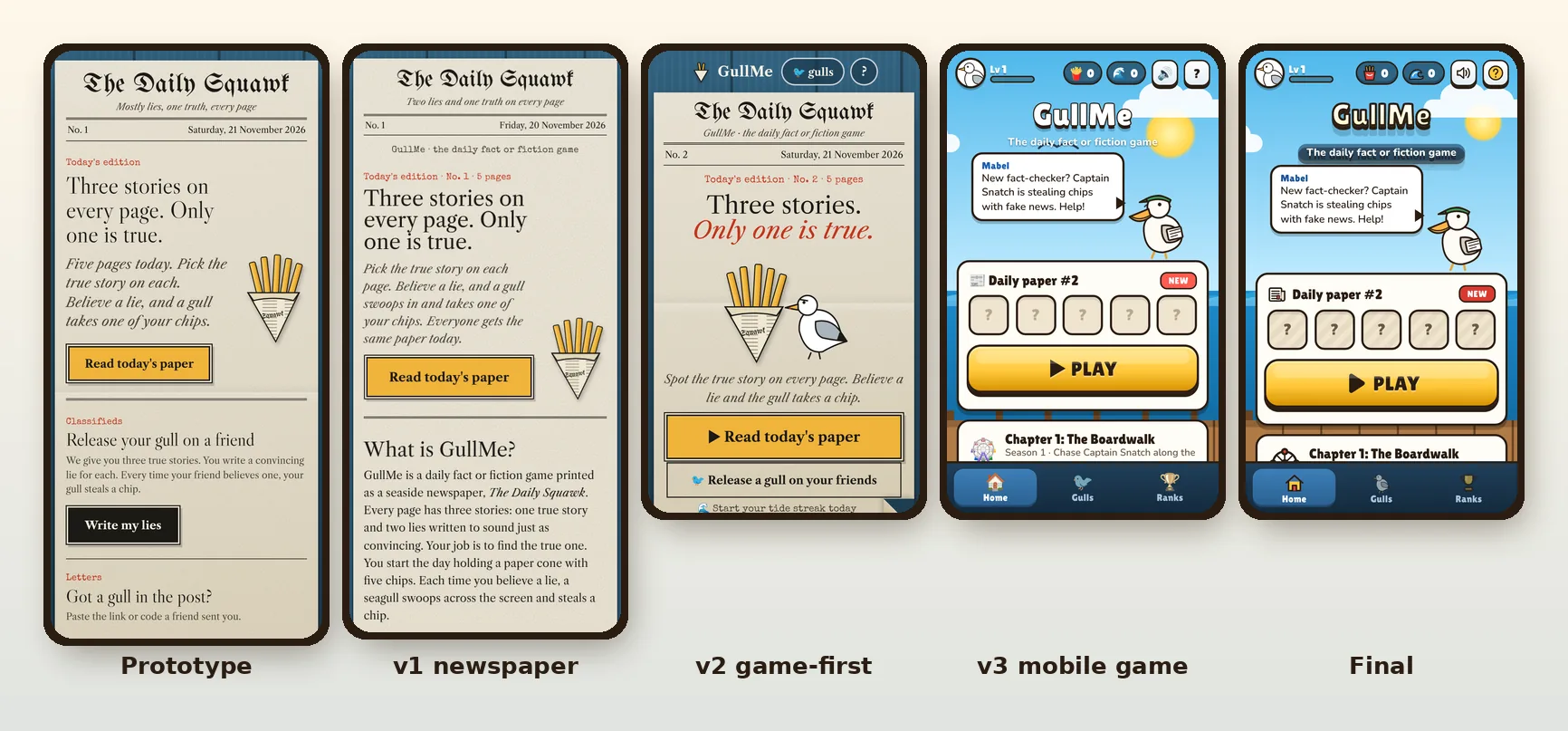
The setup: an engine, an agent and a domain
It's a website engine, but you don't edit its source code to build a site. Instead, an AI agent connects to it and builds everything as data: templates, styles, the game script, pages, images, settings. It also comes with the boring-but-hard parts already done: hosting on my own domain, a checker that blocks bad pages before they go live, analytics, and a "player service" that stores saves, leaderboards and shareable records for games.
I had already registered gullme.com and added it in the engine's admin. Then I opened Claude Code, attached a rough HTML prototype I'd made, and wrote my first request.
Step 1: "Here's the idea, but I don't like this version"
Use the GullMe.com domain and my website engine to build me a Daily Game. The design is below. The HTML is for reference, it's not the final version. I don't think the current version is good.
Look and feel: a copy of The Daily Squawk lying on blue pier boards… three statements as torn newspaper clippings… a rubber stamp comes down: blue TRUE or red GULL… your chips sit in a paper cone… each time you believe a lie, a seagull flies in and steals one chip… the answer is printed as a "Correction" box.
Game modes: Daily edition (5 pages a day, the same for everyone), Classifieds (write a lie for each of 3 true stories and send an invite link), Special edition (your friend plays your lies and can "gull you back").
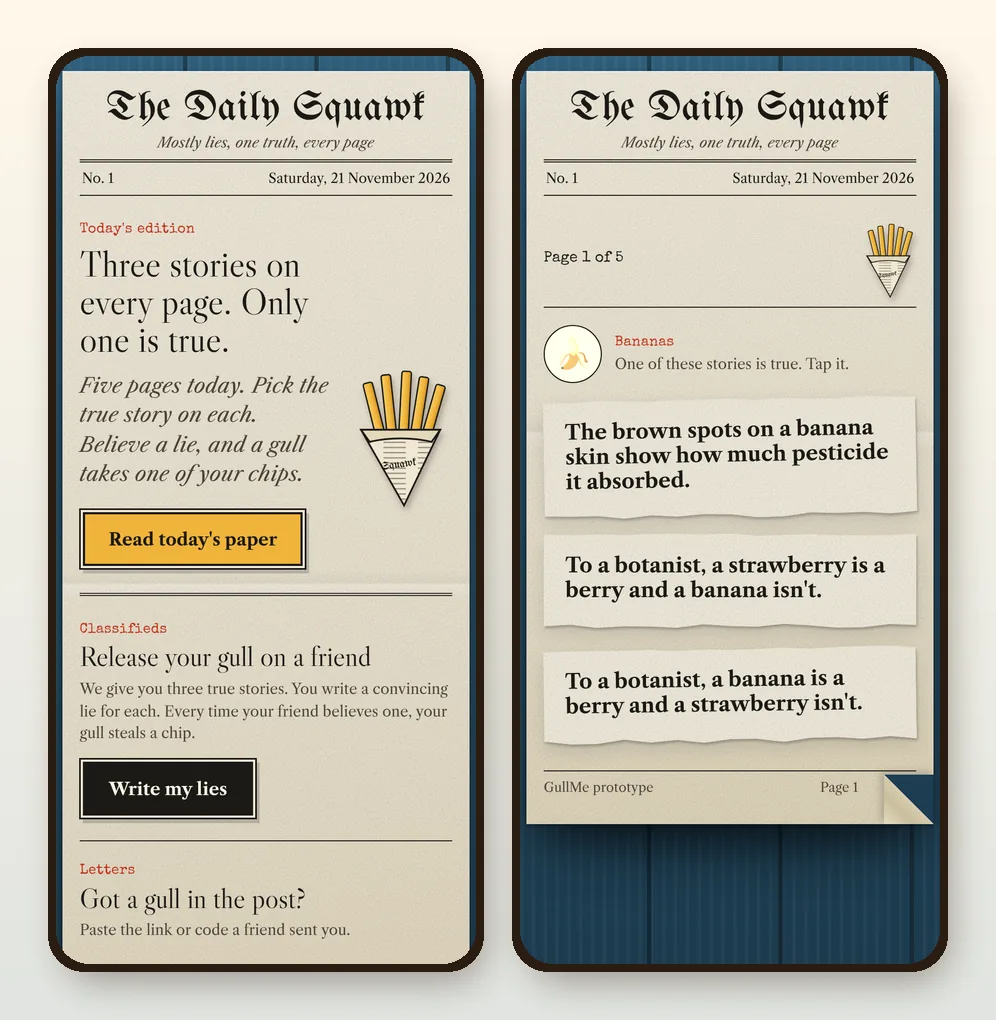
Claude Code started by reading the engine's guide and my prototype, then found the engine's admin connection in my environment. Before writing anything it checked what the engine could do, and that changed the plan. My prototype stuffed friend challenges into the URL, so nobody ever saw anyone else's results. The engine has shareable records with server-side scoring and leaderboards, so friends could finally compete on the same link.
Step 2: "This game is about spreading and bragging"
While it was working, I sent two more messages:
The focus of this game is virality and showing off.
You can rethink the gameplay.
Claude Code agreed the prototype had three problems. Writing three lies from scratch was too much effort, results only reached the creator if a friend copied them back by hand, and there was nothing to brag about. It rebuilt the loop around that:
- Creating a challenge takes about 30 seconds. For each true story you tap one of two ready-made lies, or write your own, and the dice button suggests a gull name.
- Every challenge link has a public scoreboard, the Pier Report. Post one link in a group chat and everyone sees who got fooled. The server checks each friend's answers once, so scores can't be faked or replayed.
- There's something to brag about. "Only 23% of readers got this one", your rank among today's readers, a share image instead of only emoji text, and a lifetime count of chips your gulls have stolen.
It also expanded the question bank from 16 to 32 topics and gave every true story a source. Then it published the site and tested the whole friend flow on the real domain, using two separate browsers playing creator and friend.
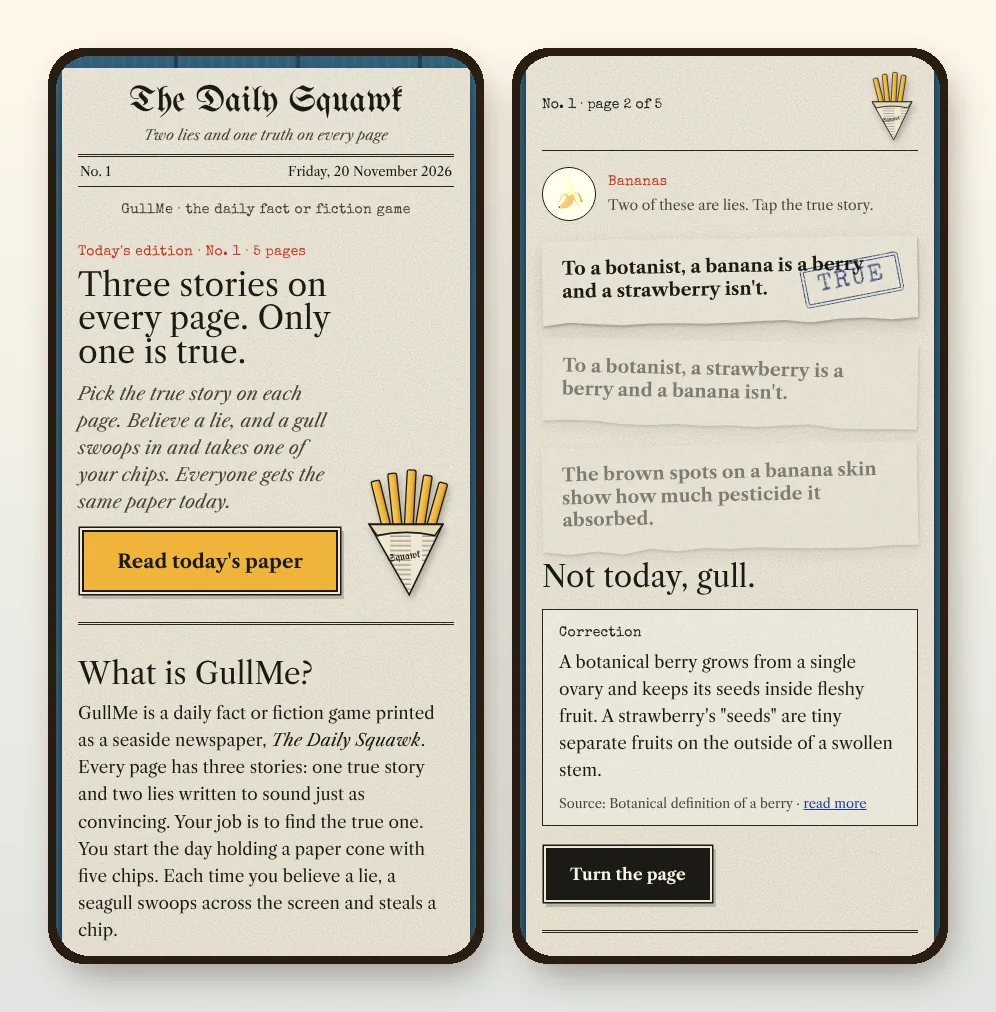
Step 3: "Make the first screen all game"
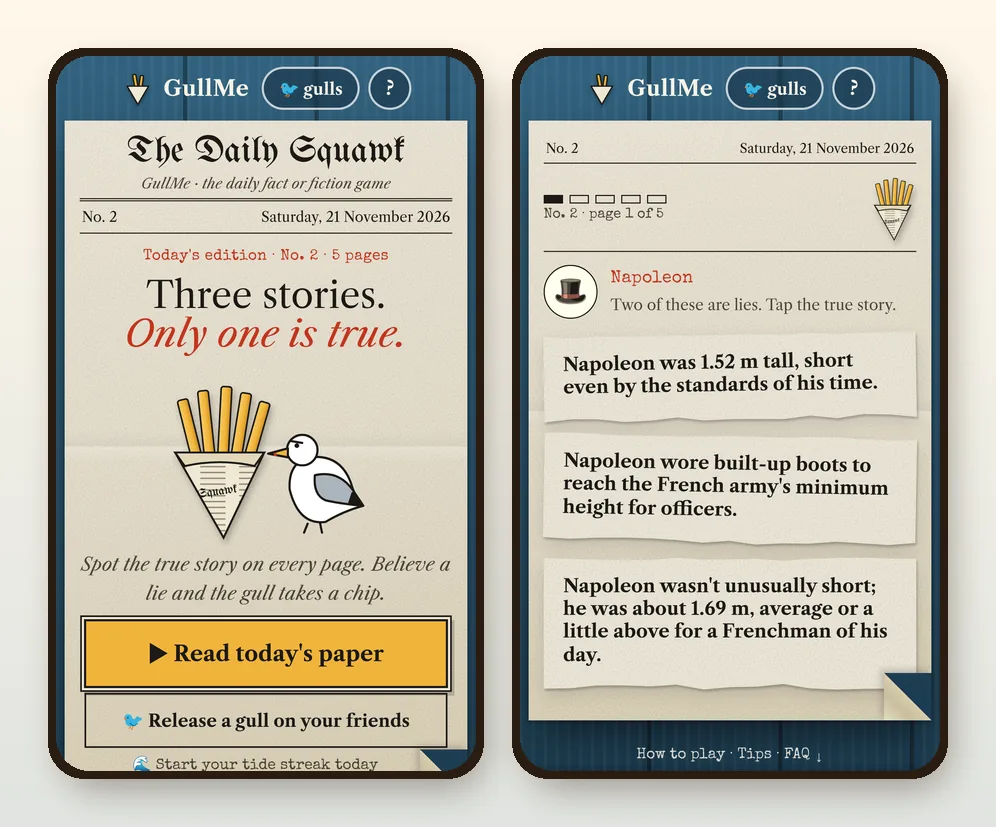
I played it and wasn't happy:
Notice how the whole page has too much text? There's no clear separation between the game at the top and the text below. I want the first screen to be all game. Make the UI look like a game interface; that's what attracts people.
We'll fix the text part later. We need real game screenshots for it, so change the game UI first.
Claude Code made the first screen a full-height game stage with a top bar, moved the answer explanation into a bottom drawer, and pushed the article into its own section below. It also took screenshots of its own work, found that the drawer covered the TRUE stamp on phones, and fixed that before showing me.
Step 4: "More like a real mobile game, and add a story"
The game interface still isn't enough. I want it more realistic, like a mobile game or online game.
A bit of story would be best.
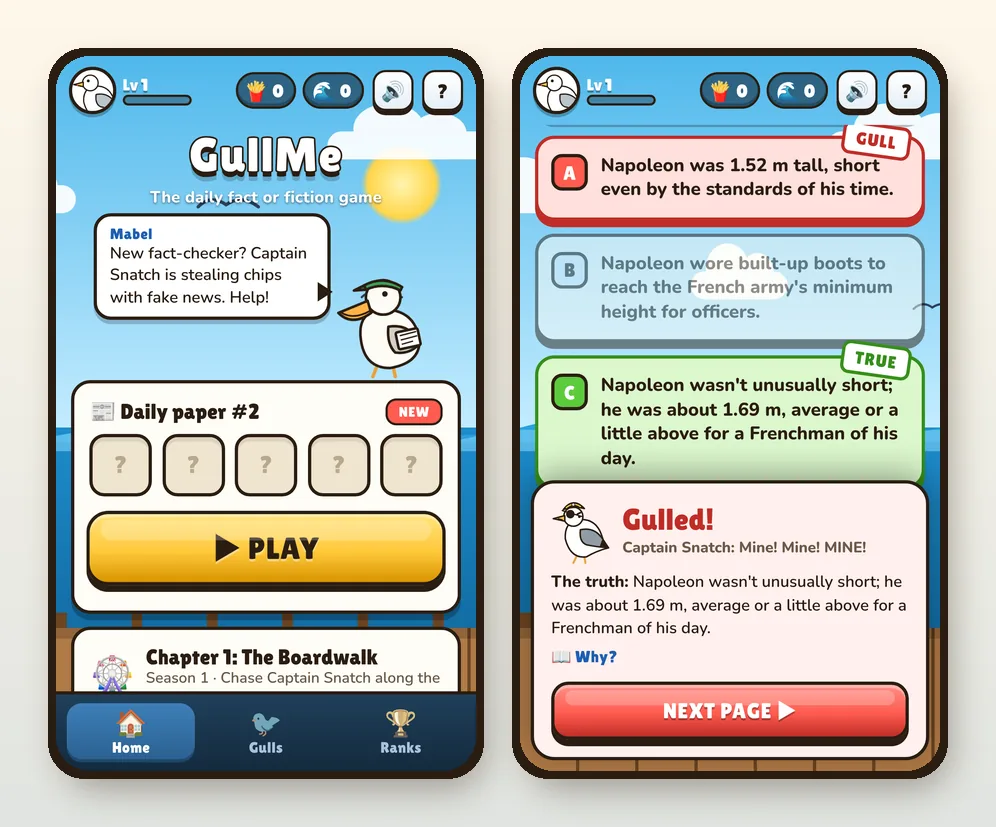
This was the biggest change. Claude Code rebuilt the interface as a mobile game: a live seaside scene with drifting clouds, waves and a pier, a top bar with level and resources, bottom tabs, chunky 3D buttons, confetti, combos, screen shake, sound effects and vibration.
For the story it created Mabel, a pelican editor in a green visor, and Captain Snatch, a one-eyed pirate gull who sneaks fake news into her paper. Season 1 is seven stops along a pier, one per day, ending at Snatch's nest on Gull Rock, with short dialogue scenes before and after each paper.
Step 5: "The emoji icons are ugly"
Take screenshots of every screen and look at them yourself. It can be more polished. And a lot of the icons are just emoji. They look ugly.
Claude Code screenshotted every screen, made a list of what looked rough, and then drew a full custom icon set: 33 interface icons, 7 icons for the story stops and 32 icons for the quiz topics, all in one sticker style with thick outlines. It checked them on a contact sheet before using them anywhere.
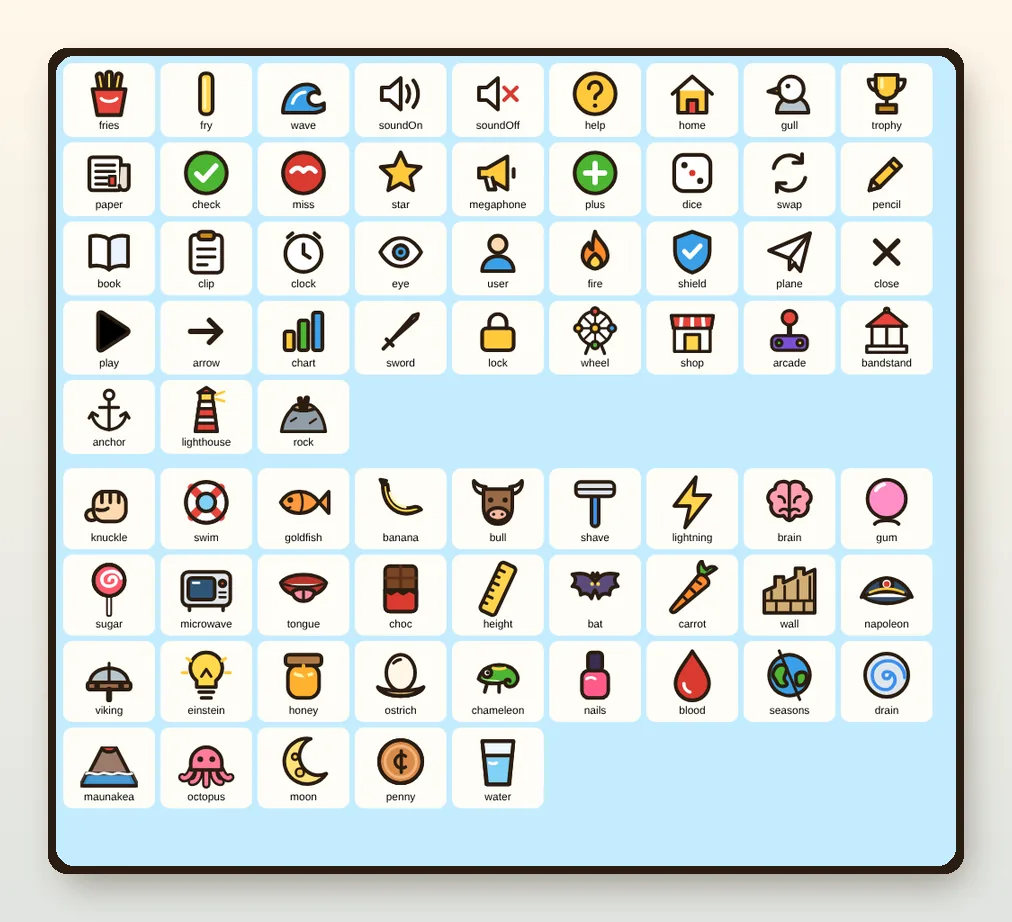
It also redrew the life counter as a red fries carton, added coloured header strips to the panels, rotating light rays behind the result stars, and pins on the wanted poster.
Step 6: Fixing what I could see and it couldn't
Some problems only showed up on my own phone, so I sent screenshots.
The bottom part is covered.
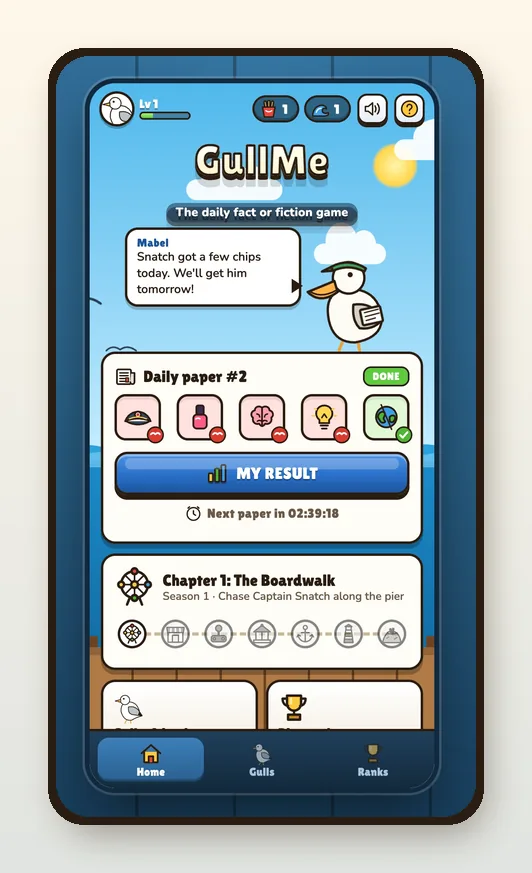
Claude Code removed two tiles that duplicated the tab bar and tightened the layout until the home screen fitted on a small iPhone SE. It also spotted that the logo had a ghost shadow and fixed it while it was there.
The text on this background is hard to read.
That was the countdown sitting directly on the brown pier. It now has a white pill behind it.
The text should be above the light rays. Right now it's underneath.
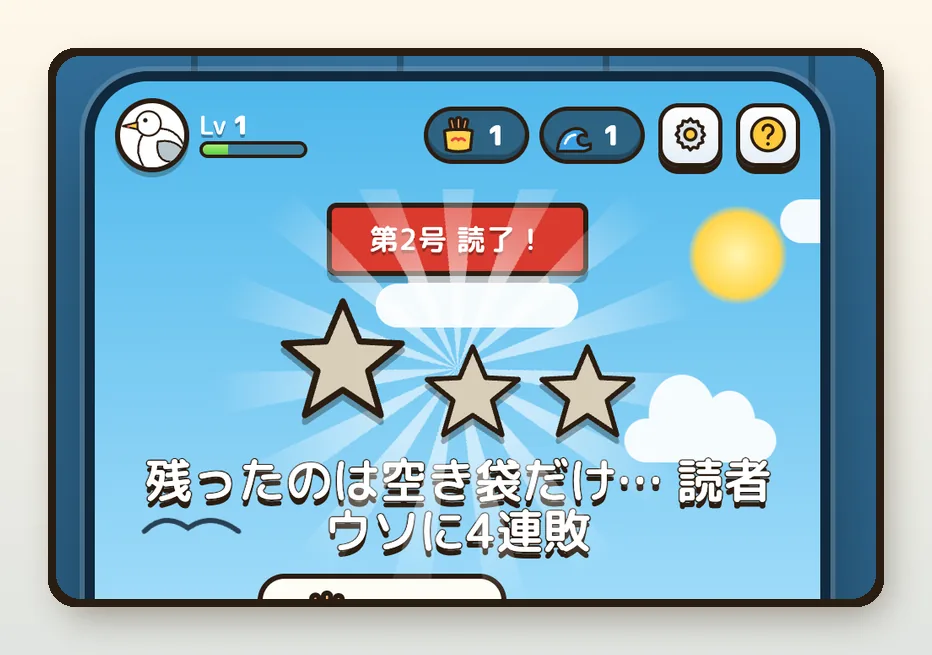
Claude Code explained the cause (the rays were a positioned layer, which browsers paint above normal text) and fixed it. While doing that it noticed the wrong star was the big one and fixed that too.
Step 7: Eight languages, adapted to local customs
Add Japanese, Korean, German, French and any other languages you think are necessary. Fit each country's and region's customs.
Claude Code warned me first: the engine's guide says adding lots of indexable language pages at once can hurt a whole site in search. We agreed to make the game itself multilingual and keep the web pages in English for now.
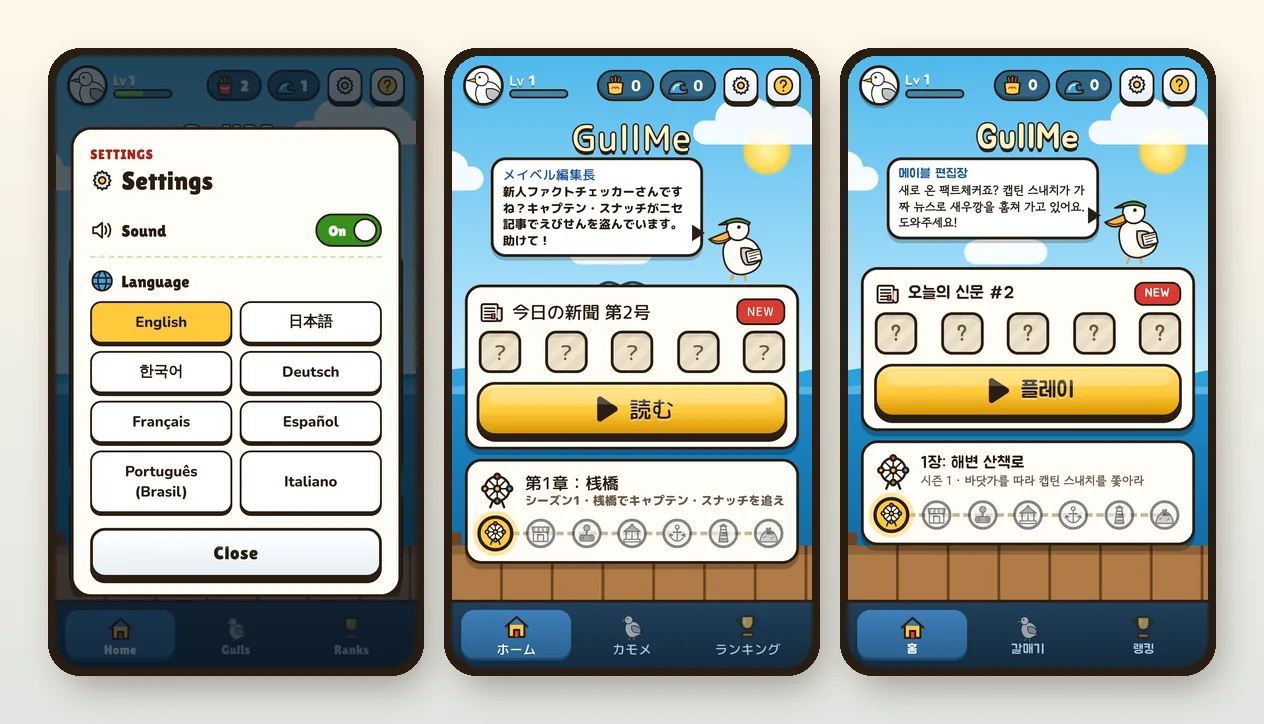
It added Spanish, Brazilian Portuguese and Italian as well, for eight languages in total. It wrote the English strings into one file and handed the other seven languages to seven helper agents working in parallel. Each one localized for its own culture rather than translating word for word. In Japan and Korea the gull steals shrimp crackers, because that's what people feed gulls on ferries there. In Spain and Brazil it's churros, and in Germany it's Pommes. The newspaper names, characters, pier stops and headlines are rewritten for each language, and Japanese and Korean get their own rounded fonts.
Then I asked:
I've played the English one already, but I haven't played the Korean one today. Shouldn't I be able to play it?
Each language should have its own leaderboard.
Now each language has its own daily paper with different questions, its own progress and story, and its own leaderboard. Friend challenges still work across languages.
Step 8: Real screenshots for the guide
Use the real game to take screenshots and write SEO copy with pictures. We only have English pages, so use the English game. You can add a section with pictures showing that the game supports several languages.
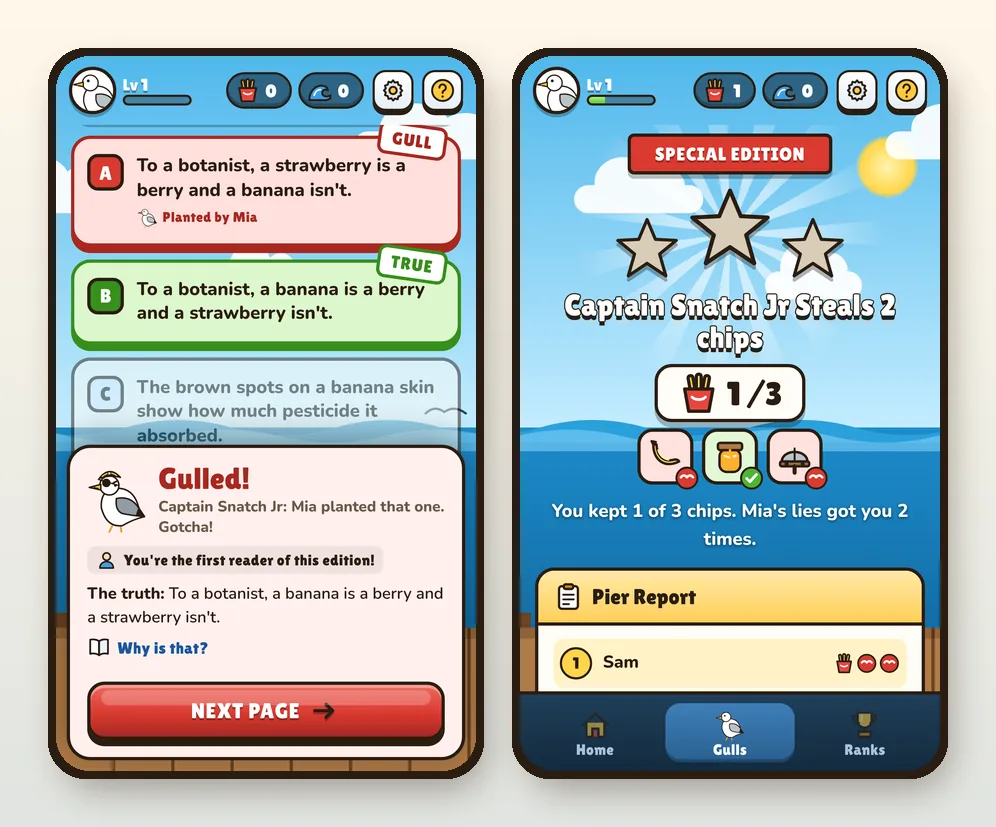
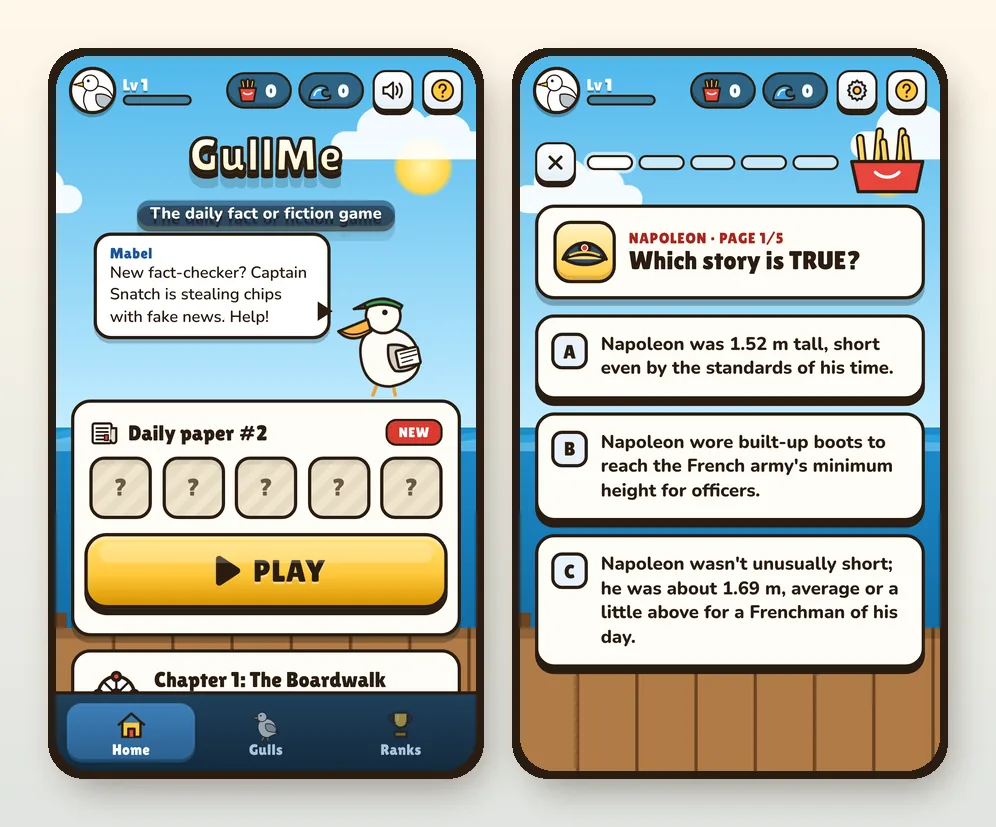
Claude Code played through the live game, including a full friend challenge with two browsers, framed the screenshots, uploaded them as images and rewrote the guide under the game. It deleted its test data afterwards and left my own score on the leaderboard alone.
What went wrong along the way
Not everything was smooth, and I'd rather tell you that than pretend:
- The preview couldn't save scores. The engine only accepts player data from the real domain, so Claude Code had to publish early and test on gullme.com.
- A broken upload. The engine accepts big files in pieces. One upload split a very long line of text in the middle, and the game failed to load. Claude Code caught it in testing, found the cause and changed how the file is built.
- Missing icons. After the language rebuild, some icons stopped showing. It was found and fixed on the next screenshot pass.
- Unverified translations. The seven translations passed an automatic check, but no native speaker has reviewed them yet. If you spot something odd in your language, please tell me.
Every time, the fix came from looking at real screenshots, either mine or Claude Code's.
How I actually worked
Looking back at the whole conversation, here's what worked for me:
- Say what you want people to feel, not how to code it. "This game is about bragging" changed more than any feature request.
- Send screenshots. One phone screenshot with "the bottom is covered" was faster than any description.
- Push back when it's not good enough. Three rounds of "still not a game" got us from a newspaper page to a mobile game.
- Let the agent check its own work. Asking Claude Code to screenshot every screen and review it caught most issues before I saw them.
Where GullMe is now
GullMe has been live for two days. Honestly, it has almost no visitors yet: the analytics so far are mostly me and Claude Code testing. It isn't in Google yet and I haven't shared it anywhere. That starts now.
If you got this far, play today's paper and see how many chips you keep. Then train a gull and send it to your group chat. And if you want to build something like this yourself, the engine is here and the agent is Claude Code.